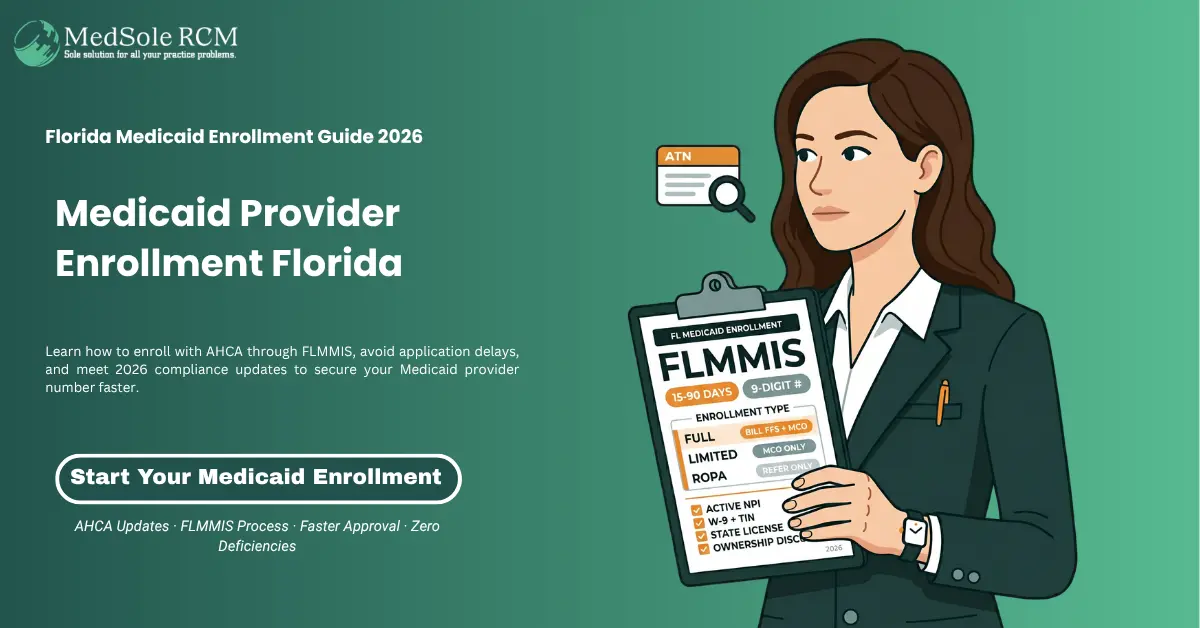




Florida Medicaid provider enrollment is the official process through which healthcare providers apply to, and receive approval from, the Agency for Health Care Administration (AHCA) via the Florida Medicaid Management Information System (FLMMIS) to bill Medicaid and receive reimbursement for covered services. Approval earns you a nine-digit Florida Medicaid provider number. That number is your billing identity inside the state system. Without it, you can't submit claims, you won't receive reimbursement, and no managed care plan can verify your participation.
2026 has made this process more layered than it was 18 months ago. AHCA is migrating to a new enterprise-level enrollment platform, SMMC 3.0 has shifted nearly all recipients into managed care, and several compliance changes have already taken effect this year. This guide covers every step of the current process and what's coming so you're not caught off guard mid-application.
It's built for individual practitioners, group practices, facilities, and out-of-state providers working through how to become a Medicaid provider in Florida. Think of it as what you'd want to know before opening the enrollment wizard, explained by someone who's already been through it.
The 2026 Florida Medicaid Enrollment Updates Every Provider Must Know
Florida medicaid provider enrollment doesn't look the same in 2026 as it did 18 months ago. AHCA has issued multiple operational changes this year, and a major system migration is underway. If you've enrolled providers before and think you already know how this works, read this section first.
The New AHCA Enterprise Provider Enrollment System Launches April 2026
The system that processes Florida Medicaid provider enrollment is changing in April 2026, and providers with pending applications need to act before the switch. AHCA Enterprise is a modernized platform, operated with Gainwell Technologies as AHCA's fiscal agent, promising 24/7 access, faster processing, and stronger security controls. The practical problem right now: applications left incomplete in the current FLMMIS wizard when the migration happens can end up in limbo with no clear resolution path.
AHCA has identified four specific actions providers should complete before the transition:
-
Complete any pending enrollments in the current Enrollment Wizard
-
Update account information in the Medicaid Secure Web Portal
-
Log in every 60 days to keep your account active
-
Subscribe to Florida Medicaid Health Care Alerts for real-time updates
We've seen what happens when providers wait out a system transition. Applications stall, phone queues grow, and the old system stops getting active attention from anyone. The AHCA provider learning series is the official training resource for the migration. Reference the FLMMIS portal for access to those materials.
DME Providers: The March 2026 Enrollment Moratorium Explained
New DME providers trying to enroll in Florida Medicaid right now can't. AHCA imposed a six-month statewide moratorium on all new Provider Type 90 applications effective March 20, 2026. It mirrors the federal CMS moratorium on DMEPOS enrollment that took effect February 27, 2026.
That moratorium applies only to new applicants. Existing enrolled DME providers can continue billing without interruption. Pharmacies, hospitals, and providers that supply DME as a secondary function fall outside this moratorium entirely. The misconception that all DME billing is paused is incorrect; only new Provider Type 90 enrollment applications are blocked.
Providers affected by this should use the pause productively. Get documents organized, background screening preparation started, and ownership disclosures drafted so you can submit the moment the moratorium window reopens.
Three More Critical Changes: NPI Requirements, Paper RAs, and the 2026 Enrollment Fee
Three additional changes affect currently enrolled providers. Effective March 27, 2026, an active NPI is required to submit claims via Direct Data Entry on the Secure Web Portal. This initially targets Provider Type 39 (Behavior Analysis), but it has broader implications for the AHCA Enterprise transition because a missing or outdated NPI can block account merging in the new system.
Paper Remittance Advices were discontinued effective March 1, 2026. All RAs are now accessed electronically through the Florida Medicaid Secure Web Portal. If your billing team was relying on mailed statements, that workflow needs to change now.
The CY 2026 federal provider enrollment application fee is $750 for institutional providers in certain enrollment scenarios, effective January 1, 2026. Non-institutional providers, including physicians and nurse practitioners, are not subject to this fee. Don't assume it applies across the board.
Keeping up with this pace of change is a full-time job on top of running a practice. If managing the enrollment transition isn't something your team has bandwidth for, our provider enrollment and credentialing services.
Who Actually Governs Florida Medicaid Provider Enrollment
Florida medicaid provider enrollment isn't managed by a single entity. Three distinct organizations are involved in the process, and knowing who does what saves significant time when something goes wrong with your application. Most providers who contact the wrong office end up on hold, get redirected, and lose days they didn't need to lose.
AHCA, FLMMIS, and Gainwell: The Three Entities Behind Your Enrollment
AHCA is the state agency that sets the rules, reviews applications, and makes the enrollment decision. It sits within the Florida state government and administers Medicaid under federal requirements set by CMS. When you receive an approval or a denial, that decision comes from AHCA.
The Florida Medicaid Management Information System (FLMMIS) is the technical platform where you actually submit your application. It's operated by Gainwell Technologies under contract with AHCA, making Gainwell the fiscal agent. The portal at portal.flmmis.com is not an AHCA website; it's AHCA's contracted system. That distinction matters when you're troubleshooting a portal access issue versus an application eligibility issue, because you're calling different people.
DCF manages something completely different. The Florida Department of Children and Families determines Medicaid eligibility for recipients, not for providers. Provider enrollment medicaid Florida questions go to AHCA, not DCF. Calling DCF about your enrollment situation gets you nowhere, and we see this mistake regularly.
What AHCA's Three Provider Enrollment Teams Actually Do
Plan and Provider Enrollment and Outreach handles your actual enrollment application, including initial submissions, renewals, and escalated issues. If your application is stuck or you need to resolve a specific problem, this team is responsible. They also deliver provider training and coordinate with managed care plans on network participation questions.
Provider Eligibility and Compliance monitors whether you stay eligible after enrollment. This team checks the OIG exclusion list, coordinates background screening processes, and handles ownership change reviews. When a provider gets flagged for an exclusion issue, this team manages the situation from that point forward.
Provider Business Module Management works on the enrollment system itself, including the AHCA Enterprise modernization. They coordinate with CMS and Medicaid Program Integrity on the technology side. Review AHCA's Provider Enrollment Hub for official contact information across all three teams.
The Three Types of Florida Medicaid Provider Enrollment: Full, Limited, and ROPA
A common misconception is that all Florida Medicaid providers enroll under the same pathway. The reality is that AHCA offers three distinct enrollment types, and choosing the wrong one can limit your ability to bill or join managed care networks. Florida Medicaid provider enrollment requirements differ depending on which category applies to you, and under SMMC 3.0 with nearly all recipients in managed care, this decision has more operational consequences than it used to.
|
Enrollment Type |
Who It Is For |
Bill FFS Directly? |
Join MCO Networks? |
|
Fully Enrolled |
Most providers billing Medicaid directly or joining managed care plans |
Yes |
Yes |
|
Limited Enrolled |
Providers in Medicaid health plan networks only |
No |
Yes |
|
ROPA (Ordering, Referring, Prescribing, and Administering) |
Providers who only order, refer, certify, or prescribe for Medicaid recipients |
No |
No |
Which Enrollment Type Do You Actually Need?
Full enrollment is the right choice for most providers who want to actively participate in Florida Medicaid. If you plan to see Medicaid patients and bill for those services, either through fee-for-service or through a managed care plan, full enrollment is your path. Before starting the medicaid provider enrollment application, confirm your specific provider type supports full enrollment using the FLMMIS Provider Types and Specialties list, updated July 25, 2025.
Limited enrollment makes sense only for providers who will exclusively see Medicaid patients through a managed care plan and never bill fee-for-service directly. The distinction matters because limited enrolled providers can't submit claims directly to Medicaid. If your revenue model shifts toward fee-for-service later, you'll need to change your enrollment type, and that means a new application.
ROPA enrollment is the narrowest pathway. If you're a physician who refers patients to Medicaid services but doesn't directly provide or bill for those services, ROPA covers your participation. Many specialists operating primarily in commercial payer networks still need ROPA enrollment to legally write referrals for Medicaid recipients. Don't skip it if it applies to you.
Step-by-Step: How to Complete Your Florida Medicaid Provider Enrollment
Completing Florida Medicaid provider enrollment means submitting an application through the FLMMIS Enrollment Wizard at portal.flmmis.com with an active 10-digit NPI, all required licensure documentation, a W-9 matching your Tax ID exactly, and ownership disclosures for every principal holding 5% or more. Background screening through AHCA's Clearinghouse runs simultaneously. Once approved, you receive a nine-digit Florida Medicaid provider number. Here's the full florida medicaid provider enrollment process, step by step, including the details most guides never mention.
Step 1: Determine Your Provider Type and Gather Requirements
Before opening the florida medicaid provider enrollment portal, identify your provider type from AHCA's Provider Types and Specialties list. Your provider type determines your enrollment pathway, required documents, screening level, and renewal cycle. Getting it wrong at the start means your application gets rejected after weeks of waiting, and you start over from scratch.
At minimum, you'll need: an active 10-digit NPI from NPPES, a current state license or certification, your Tax Identification Number (TIN or EIN), and proof of malpractice insurance where required. Group practices need a separate group NPI in addition to each individual NPI.
Pre-enrollment checklist before Step 2:
-
Active NPI matching your enrollment entity type
-
Current state license or certification (all applicable licenses)
-
TIN or EIN matching all application documents exactly
-
Signed W-9
-
Proof of malpractice insurance
-
Ownership disclosure documentation for all principals holding 5% or more
-
Managing employee details
Step 2: Create Your Account and Access the FLMMIS Enrollment Wizard
Go to portal.flmmis.com and navigate to the New Medicaid Providers section. Account creation is required before you can access the Enrollment Wizard. If you've enrolled before, log into your existing account rather than creating a new one; duplicate accounts create tracking problems during review.
The Enrollment Wizard saves progress automatically and generates your Application Tracking Number (ATN) once enough data has been entered. That ATN is critical throughout the process. It's how you check your status, how you continue a saved application, and how AHCA identifies your file.
Once the ATN is issued, six fields lock permanently and cannot be changed: Application Type, Enrollment Type, Provider Type, CHOW indicator, Tax ID, and Tax ID Type. Get these right before the wizard locks them. Choosing the wrong enrollment type at this stage means starting the entire application over from the beginning.
Step 3: Complete the Application and Upload Every Required Document
The application asks for ownership and controlling interest details for every person holding 5% or more in the practice. This is where most applications stall. Providers routinely underestimate the documentation the ownership section requires, especially for multi-provider practices or practices with outside investors.
Document uploading happens inside the wizard itself. The application can't be submitted until every required document is uploaded and accounted for. Don't upload in batches across multiple sessions; incomplete document packets at submission trigger a deficiency review that adds weeks to your timeline.
Three deficiency triggers that AHCA's own guidance identifies as most common: background screening results not received, supporting documentation signed by someone not listed in the ownership section, and proof of Tax ID not matching the application information exactly. All three are preventable with upfront organization.
Step 4: Complete Level II Background Screening Through AHCA's Clearinghouse
Background screening is required for owners, managing employees, and board members. The level depends on your provider type: Limited, Moderate, or High risk. High-risk categories, including home health and DME providers, require fingerprint-based Level II background screening through an AHCA-approved Livescan vendor.
Timing is critical here. First-time applicants must submit the Medicaid application and receive their ATN before starting the Clearinghouse process. Starting background screening before you have your ATN creates a tracking mismatch that delays the entire application, not just the screening portion.
Start through AHCA's Care Provider Background Screening Clearinghouse immediately after receiving your ATN. Background check results can take two to four weeks. AHCA won't approve your application without them, so waiting costs you that entire window.
Step 5: Submit and Track Your Application Using Your ATN
After everything is uploaded and background screening is initiated, submit the application through the wizard. From that point, track your florida medicaid provider enrollment status using your ATN at the FLMMIS Enrollment Status page.
AHCA's published processing timeframes show "In process" status averaging approximately 14 business days. Total enrollment from submission to approval, including background screening, typically runs 15 to 90 days depending on application type and completeness.
Step 6: Approval, Provider Number Issued, and Secure Portal Access
Approved providers receive a Welcome Letter and a nine-digit Florida Medicaid provider number. That number is your billing identity. It goes on your claims, payers reference it for enrollment status verification, and managed care plans use it to confirm your network participation.
You'll also receive a PIN letter by mail within 10 business days of activation. Follow the activation instructions at public.flmmis.com/public/pinletter/ to access your secure web portal account. Without completing this step, you can't access your RAs, eligibility verification tools, or account details.
One more step most enrollment guides never mention: for most Florida Medicaid services, your provider number approval is only part of the process. You'll still need to contract with the managed care organizations serving your area before you can bill for the majority of Medicaid recipients.
The enrollment wizard isn't intuitive, and the ATN locking issue alone causes hundreds of application restarts every year. If you'd rather get it right the first time, our team handles the complete enrollment process.
Florida Medicaid Provider Enrollment Requirements: What You Need Before You Apply
Your NPI must be active and associated with the correct taxonomy code before you open the FLMMIS wizard. That's the single most important pre-application requirement for meeting Florida Medicaid provider enrollment requirements. Everything else on this list matters too, but an inactive or mismatched NPI stops your application before it gets anywhere. Gather everything below before touching the portal.
|
Document Category |
Specific Requirement |
Notes |
|
Provider Identity |
Active 10-digit NPI from NPPES |
Must match enrollment entity type |
|
Tax Documentation |
W-9 with current EIN or SSN |
Must match application exactly |
|
Licensure |
Current state license or certification |
All applicable licenses |
|
Insurance |
Proof of malpractice insurance |
Where required by provider type |
|
Ownership Records |
Disclosure for all 5%+ owners |
Includes managing employees |
|
Background Screening |
Level II fingerprint results via Clearinghouse |
High-risk provider types |
|
Application Form |
AHCA Form 2200-0003 (where applicable) |
Provider-type specific |
|
Surety Bond |
$50,000 bond per Florida Statute 409.907 |
Certain FFS provider types |
|
Group Documentation |
Group NPI separate from individual NPI |
Group practice enrollment |
Why Missing One Document Costs You Weeks
A common mistake providers make is starting the florida medicaid provider enrollment application before gathering all required documents. The wizard can't be submitted until every document is uploaded, and uploading in batches across multiple sessions creates a tracking mismatch that delays approval by weeks.
AHCA reviews applications in the order received. When a deficiency is found, your application doesn't just pause; it cycles through an additional review process. The three most common document deficiencies: background screening not initiated or completed, ownership documents signed by someone not listed in the ownership section, and Tax ID proof that doesn't match the application exactly.
The fix requires organization before submission. Collect every document on the checklist above, verify that signatures match authorized signers in your ownership disclosure, and confirm your Tax ID appears identically on every single document. One discrepancy between your W-9 and your application triggers a deficiency review immediately.
CAQH ProView is already part of your credentialing workflow for many practices, meaning much of this documentation is already organized there. The challenge is that CAQH data doesn't automatically transfer into the FLMMIS wizard; each document must be manually uploaded separately.
How Long Does Florida Medicaid Provider Enrollment Take?
Florida Medicaid provider enrollment takes 15 to 90 days from application submission to approval, depending on your provider type, the completeness of your application, and whether background screening triggers additional review. Applications submitted without deficiencies process significantly faster than those that require correction cycles.
|
Application Stage |
Average Timeframe |
|
Application review ("In process" status) |
Approximately 14 business days |
|
Background screening (Level II) |
2 to 4 weeks after ATN issued |
|
Quality control review (if triggered) |
Additional 5 to 10 business days |
|
Full enrollment, no deficiencies |
15 to 45 days |
|
Full enrollment, with deficiencies |
45 to 90 days |
|
PIN letter delivery after approval |
Within 10 business days |
What Usually Slows Down the Process
The 90-day end of that range isn't typical for a clean application. It's what happens when deficiencies pile up and each correction cycle adds processing time because the application re-enters the review queue. Two or three correction cycles can push a submission past 90 days with no guaranteed end date in sight.
Here's what actually causes the long timelines: background screening delays from using a non-approved Livescan vendor, document deficiencies discovered after submission, ownership disclosure issues requiring AHCA to request additional information, and the ATN locking problem where providers have to restart the entire application because they selected the wrong enrollment type at the start.
Checking your florida medicaid provider enrollment status regularly using your ATN at the FLMMIS Enrollment Status page is the only reliable way to catch deficiency notices quickly. AHCA sends notices to the contact email on file in your account. If that email is outdated, you won't know there's a problem. Your medicaid provider enrollment status will still show "In process" while your application sits in deficiency review.
If your enrollment is stuck or you're starting fresh and want to avoid the correction cycle, our provider enrollment specialists handle submissions for $99 per payer.
The Florida Medicaid Provider Agreement: What You Are Legally Agreeing To
The Florida Medicaid Provider Agreement is a legal contract governed by Florida Statute 409.907 that all enrolled providers must sign before billing Medicaid. It requires full compliance with applicable state and federal Medicaid laws, maintenance of active professional licensure, background screening for high-risk provider categories, adherence to network access standards, and a $50,000 surety bond for certain fee-for-service provider types. Signing it commits you to these obligations for the full term of your florida medicaid provider enrollment, and it's voidable the moment ownership of your practice changes.
What the Provider Agreement Actually Requires From You
The provider agreement isn't just a signature on a form. It's a legal commitment to comply with every applicable state and federal Medicaid law, maintain your professional licensure in good standing, and meet the network access standards tied to your florida medicaid provider enrollment requirements. Signing it binds you to these conditions for the duration of your enrollment.
The agreement must be signed by an authorized agent. Per AHCA's guidance, a CEO or president can sign on behalf of all principals. That specific authorization matters because agreements signed by someone not recognized as an authorized agent are considered invalid and trigger a deficiency review that restarts the clock.
One condition that regularly catches providers off guard: the agreement is voidable upon a change of ownership. If you sell your practice or acquire one, the existing provider agreement tied to that Medicaid ID doesn't automatically transfer to the new owner. It terminates. The CHOW section below covers this in detail.
|
Requirement |
Details |
Who It Applies To |
|
Legal compliance |
Full adherence to state and federal Medicaid law |
All enrolled providers |
|
Active licensure |
Current state license maintained throughout enrollment |
All enrolled providers |
|
Background screening |
Level II fingerprints through Clearinghouse |
High-risk provider categories |
|
Network access standards |
Appointment wait times and quality benchmarks |
Managed care network participants |
|
Authorized signature |
CEO or president signs on behalf of principals |
All applicants |
|
Surety bond |
$50,000 minimum per Florida Statute 409.907 |
FFS crossover provider types |
|
Non-institutional agreement |
Signed before billing as non-institutional provider |
Non-institutional provider types |
The $50,000 Surety Bond Requirement: Who Needs It and What It Costs
Under Florida Statute 409.907, certain providers must file a $50,000 surety bond before billing Medicaid on a fee-for-service basis. This applies to crossover providers processing money on a fee-for-service or non-cost-based fee schedule. Bond premium rates start at approximately $1,000 annually, depending on credit profile.
DME providers face a second requirement. If you're a DMEPOS supplier, you need a separate federal $50,000 surety bond to bill Medicare in addition to the Florida Medicaid bond. These are two distinct requirements from two different programs. Don't assume one covers the other; that assumption creates a billing gap you won't catch until claims start rejecting.
The OIG exclusion list check runs as part of the agreement compliance process. If any owner or managing employee appears on the OIG or LEIE, AHCA will deny the application regardless of how complete the rest of the submission is. There's no workaround for an active exclusion.
Florida Medicaid Provider Enrollment Renewal: What Happens If You Miss the Window
Per 42 CFR 455.414, AHCA must revalidate all enrolled providers at least every five years. But that five-year cycle doesn't apply to everyone. A common misconception is that all Florida Medicaid provider enrollment renewal cycles are five years. The actual rule varies by provider type: institutional providers, DME suppliers, ordering and referring providers (ORP), and out-of-state providers renew every three years under AHCA's enrollment policy. Non-institutional providers operate on the federal five-year baseline. Assuming the wrong cycle means missing a renewal window and watching claims suspend without warning.
|
Provider Category |
Renewal Cycle |
Notes |
|
Non-institutional providers |
Every 5 years |
Per 42 CFR 455.414 federal baseline |
|
Institutional providers |
Every 3 years |
Per AHCA enrollment policy |
|
DME suppliers |
Every 3 years |
Per AHCA enrollment policy |
|
Ordering, Referring, Prescribing (ORP) |
Every 3 years |
Per AHCA enrollment policy |
|
Out-of-state providers |
Every 3 years |
Per AHCA enrollment policy |
How the Renewal Process Actually Works
AHCA mails renewal notices approximately 90 days before your provider agreement expires. That notice goes to the contact information on file in your FLMMIS account. If your contact information is outdated, you won't receive it. Your agreement will still expire, claims will still suspend, and the system won't wait while you figure out what happened.
The renewal link only appears in your secure portal account within that 90-day window before expiration. You can't initiate florida medicaid provider enrollment renewal earlier than that window opens. Logging in outside the renewal window and not finding the option creates confusion for providers trying to get ahead of the deadline.
Providers with multiple base IDs receive a separate renewal notice for each base ID, approximately 90 days before each agreement expires. The expiration dates don't necessarily align. A group practice with five base IDs could have five different renewal windows in the same calendar year, each requiring separate completion.
When medicaid provider enrollment isn't renewed by the expiration date, claims suspend until the renewed agreement is approved and released. That suspension period isn't retroactively reimbursed in most cases. Revenue that doesn't get billed during a suspension is revenue that doesn't come back.
How to Make Sure You Never Miss a Renewal Deadline
Subscribe to Florida Medicaid Health Care Alerts and keep your portal contact information current. Those two steps alone prevent most renewal surprises. Log into your FLMMIS account at least every 60 days, not just for renewal tracking but because accounts inactive past 60 days have passwords expire, and accounts locked beyond 120 days can be terminated entirely.
Build your florida medicaid provider enrollment renewal window into your annual billing calendar. If your agreement expires in October, the renewal window opens in July. Mark July on the calendar, not October. Catching the renewal early gives you time to address any documentation updates without a deadline pressing down on you.
Managing multiple renewal cycles across multiple provider IDs is where enrollment maintenance gets genuinely difficult. If you want someone tracking your renewal windows so claims never suspend, that's part of what our provider enrollment and credentialing services team manages.
Change of Ownership in Florida Medicaid: Why Your Provider ID Does Not Transfer
A common and costly assumption is that purchasing a medical practice means inheriting its Medicaid provider number. That assumption is wrong. When providers buy or sell a medical practice in Florida, the Medicaid provider number tied to that practice doesn't transfer to the new owner. This is what AHCA defines as a Change of Ownership, or CHOW, and it triggers a mandatory new florida medicaid provider enrollment process for the incoming owner.
What Triggers a CHOW and What It Means for Your Enrollment
AHCA defines a CHOW as a transfer of ownership exceeding the 51% threshold for most provider types. This includes transfers through sale, stock transfer, merger, or lease. A management company change or board restructuring alone doesn't necessarily trigger a CHOW. An equity transfer past the 51% mark almost always does.
When a CHOW is triggered, AHCA reviews the transaction before approving continued enrollment. That review checks whether any pending enforcement action by Medicaid Program Integrity or the Medicaid Fraud Control Unit (MFCU) exists against either the seller or the buyer. Outstanding money owed by the seller can create a barrier to buyer enrollment approval, and that's not a detail most acquisition attorneys flag proactively.
Most provider types submit CHOW disclosure through the FLMMIS Enrollment Wizard. Hospitals, SNFs, and ICFs use a separate CHOW disclosure form. Regardless of method, the CHOW submission must happen before the transaction closes if you want any chance of avoiding a gap in Medicaid billing.
During the gap between the old provider's enrollment termination and the new owner's approval, no one can bill Medicaid for services provided at that practice. If that gap runs 45 to 90 days, the revenue loss is substantial and unrecoverable.
Building CHOW Into Your Practice Transaction Checklist
Treat the CHOW enrollment as a hard deadline item in the transaction closing checklist, the same way you'd treat the physical facility license transfer or the DEA registration update. Transaction attorneys often aren't billing experts and won't flag the Medicaid enrollment timing issue unless a billing professional raises it first.
Start the new owner's medicaid provider enrollment as early in the due diligence period as possible. Background screening alone takes two to four weeks. The full enrollment process can run another 30 to 60 days after that. Starting at closing means starting too late.
Practice acquisitions have tight timelines and complicated enrollment implications. Our provider enrollment services team has managed CHOW transitions for practices across Florida.
Out-of-State Provider Enrollment in Florida Medicaid: When It Is Required
Out-of-state providers who furnish Medicaid-covered services to Florida recipients must enroll in Florida Medicaid to receive reimbursement. This requirement applies under Rule 59G-1.050 of the Florida Administrative Code. Approval in Medicare or Medicaid in another state doesn't guarantee eligibility for florida medicaid provider enrollment out of state applications. Each state program operates independently, and Florida requires its own application, its own review, and its own provider number issued separately from any other state's credential.
When Florida Medicaid Pays Out-of-State Providers
Florida Medicaid reimburses out-of-state providers under four specific circumstances: emergency services provided while the recipient was temporarily outside Florida, situations where required travel back to Florida would endanger the recipient's care, certain foster care and adoption subsidy scenarios, and prior-authorized medically necessary services that aren't available within the state.
The application process for out-of-state providers differs slightly from in-state enrollment. Out-of-state providers typically submit documentation to AHCA's Provider Enrollment mailing address rather than completing the full online wizard process. Florida Medicaid out-of-state providers also operate on a three-year medicaid provider enrollment renewal cycle, not the five-year cycle that applies to most in-state non-institutional providers.
Retroactive enrollment is possible for out-of-state providers who have already rendered eligible services before completing enrollment. If you've provided qualifying services but haven't enrolled yet, retroactive enrollment for those specific service dates may be available. Document service dates carefully and initiate the enrollment process as quickly as possible to preserve that window.
After Enrollment: Contracting With Florida Medicaid Managed Care Plans Under SMMC 3.0
Getting your nine-digit Medicaid provider number from AHCA is step one of a two-part process. For most Florida providers, step two is equally important: contracting with the managed care organizations that actually pay claims for the majority of florida medicaid provider enrollment-eligible recipients. Under SMMC 3.0, almost no Medicaid recipients remain in traditional fee-for-service, which means your provider number alone doesn't get you paid for most Medicaid patients walking through your door.
Why SMMC 3.0 Makes MCO Contracting Non-Negotiable
Beginning February 2025, AHCA began auto-assigning virtually all eligible Florida Medicaid recipients into a managed care plan under SMMC 3.0. Most patients presenting at your practice are enrolled in an MCO, not traditional fee-for-service Medicaid. If you're not contracted with their plan, you're billing as an out-of-network provider, and most plans don't cover out-of-network for routine services.
Being enrolled with AHCA but uncontracted with an MCO creates a specific billing problem. You have a valid Medicaid provider number, but the plan won't process your claims as in-network. This is one of the most common causes of denial management issues for newly enrolled providers, and it's almost entirely avoidable with proper post-enrollment planning.
The major managed care plans serving Florida Medicaid recipients include Sunshine Health, Simply Healthcare, Clear Health Alliance, Humana Medicaid, and Molina Healthcare, among others. Each plan runs its own credentialing and contracting process separate from AHCA enrollment. Most use Availity Essentials as their primary provider portal for eligibility verification, authorization, and claims submission.
How to Contact Florida Medicaid Managed Care Plans for Contracting
Contact each MCO directly to initiate network participation. For Sunshine Health, providers can submit a network participation request through the plan's provider portal or call their provider services line at 1-844-477-8313. Each plan has its own application timeline, credentialing requirements, and effective date process. Don't assume AHCA enrollment automatically notifies managed care plans, because it doesn't.
MCO credentialing typically requires an active CAQH ProView profile. Keep your CAQH profile current and attestation up to date before approaching managed care plans, because most pull credentials directly from CAQH rather than requesting separate documentation. An outdated CAQH profile delays MCO contracting the same way a deficient AHCA application delays enrollment.
The revenue cycle management implications of MCO contracting don't end at network participation. Each plan has different authorization rules, claim submission formats, and denial management processes. Getting enrolled and contracted is the beginning of an ongoing billing relationship that requires active management across every payer you're signed with.
Managing MCO contracting across multiple plans while running a practice is a significant administrative workload. Our revenue cycle management team handles credentialing, contracting, and claims across all Florida Medicaid managed care plans — 2.99% of collections.
Provider Enrollment Versus Credentialing: Two Separate Processes Most Providers Confuse
Yes, an individual provider typically needs to complete three separate processes to fully participate in Florida Medicaid: enrollment with AHCA to obtain a provider number, credentialing with individual managed care plans to verify clinical qualifications, and contracting with those plans to establish network participation terms. Provider enrollment and credentialing are related but distinct, and conflating them is one of the most common mistakes newly enrolling practices make. Completing Florida Medicaid provider enrollment doesn't mean you've completed credentialing, and completing credentialing doesn't mean you're contracted.
|
Process |
Governing Body |
What It Does |
Outcome |
|
Provider Enrollment |
AHCA via FLMMIS |
Confirms legal eligibility to bill Florida Medicaid |
Nine-digit Medicaid provider number |
|
Credentialing |
Individual MCOs and payers |
Verifies clinical qualifications, licenses, and malpractice history |
Approved to practice within the plan's network |
|
Network Contracting |
Individual MCOs |
Establishes fee schedule and participation terms |
In-network status and claims payment |
Why Enrollment Does Not Automatically Mean You Are Credentialed
Getting your Medicaid provider number from AHCA confirms the state recognizes you as an eligible provider. It doesn't mean any managed care plan has verified your clinical credentials. Healthcare provider credentialing is the plan's own separate process of confirming your license is current, your malpractice history is acceptable, and you meet their specific participation standards.
Healthcare provider credentialing through managed care plans typically takes 60 to 120 days per plan. Each plan runs its own credentialing committee, operates on its own timeline, and applies its own criteria. Starting credentialing applications before AHCA enrollment is complete is possible and often advisable, because it minimizes the gap between provider number issuance and your first paid claim.
How to get credentialed with Medicaid managed care plans in Florida: maintain an active, fully attested CAQH ProView profile, submit credentialing applications directly to each plan or through a credentialing verification organization, and track each application separately. Medicaid credentialing through Florida's major plans typically requires the same documentation set as your AHCA enrollment application. Review our guide to credentialing services in Florida for the full credentialing breakdown.
How MedSole RCM Handles Both Enrollment and Credentialing for Florida Providers
Most provider enrollment and credentialing services treat enrollment and credentialing as two separate engagements billed separately. MedSole handles both as a coordinated workflow. When enrollment and credentialing run in parallel rather than sequentially, providers reach their first paid claim weeks faster than the sequential approach most practices take on their own.
The pricing is straightforward: $99 per payer enrollment covers the complete AHCA enrollment submission through provider number issuance. Credentialing with individual MCOs and commercial payers runs at the same $99 per payer rate. No percentage of your reimbursements is tied up in the enrollment process, and there are no hidden fees based on correction cycles or application length.
Revenue cycle management starts at enrollment. Providers who get enrolled and credentialed correctly from the first submission avoid the denial patterns that follow a flawed enrollment. Clean enrollment leads to clean claims. Learn more about our outsourced medical billing services if full-service billing is part of what your practice needs.
If you're starting enrollment from scratch or recredentialing after a lapse, we'd be glad to walk through the timeline with you — no commitment required.
Why Healthcare Providers Across Florida Choose MedSole RCM for Enrollment and Credentialing
The enrollment process we've described in this guide is manageable if you have a billing team with the right capacity and experience. Most practices don't have that combination available alongside clinical operations. The florida medicaid provider enrollment timeline alone, 15 to 90 days with multiple documentation requirements, background screening coordination, and ATN tracking responsibilities, is significant administrative burden that falls on whoever's managing it.
What MedSole RCM Actually Does for Enrolled Providers
MedSole handles the complete provider enrollment and credentialing workflow: document collection, application preparation, FLMMIS wizard submission, background screening coordination, ATN tracking, deficiency response, and provider number follow-through. The $99 per payer enrollment rate covers the entire process from initial document collection to approved provider number. There are no additional fees tied to the length of the process or the number of correction cycles required.
For practices that also need medical billing and revenue cycle management, MedSole's billing service runs at 2.99% of collections. That covers claims submission, AR follow-up, denial management, and payer follow-up across all payers including Florida Medicaid fee-for-service and all major managed care plans. Most full-service billing companies charge between 5% and 8%.
The connection between enrollment accuracy and billing performance is direct. Providers whose enrollment is handled correctly from the start have cleaner claims, fewer eligibility-related denials, and faster reimbursement cycles. Providers who enroll themselves and make application errors carry those errors into their billing workflow until someone catches and corrects them.
The Pricing Comparison: MedSole Versus Managing Enrollment In-House
Managing florida medicaid provider enrollment in-house requires staff time across multiple weeks for document collection, application completion, background screening coordination, and status monitoring. For a single provider enrollment, that time typically runs eight to 15 hours depending on application complexity. At an average biller rate of $20 to $25 per hour, in-house enrollment costs $160 to $375 in labor alone before accounting for any correction cycles.
MedSole's $99 per payer enrollment rate falls below that labor cost estimate for even the simplest in-house application, and it includes error correction at no additional charge. For practices with multiple providers enrolling simultaneously, the cost differential becomes more pronounced with each additional provider added to the process.
If you want to know exactly what enrollment and credentialing looks like for your specific provider type and specialty, reach out — we'll give you a straight answer.
Frequently Asked Questions About Florida Medicaid Provider Enrollment
How do you enroll in Florida Medicaid as a provider?
Submit an online application through the FLMMIS Enrollment Wizard at portal.flmmis.com. Before you start, you'll need an active 10-digit NPI, current state licensure, your Tax ID, and supporting documents including a W-9 and ownership disclosures for all principals holding 5% or more. After submission, you'll receive an ATN to track your application status. Background screening through AHCA's Clearinghouse runs simultaneously with the application review. Approved providers receive a nine-digit Medicaid provider number. For direct assistance, AHCA's Provider Enrollment help line is reachable at (850) 300-4323, Option 4.
How long does Florida Medicaid provider enrollment take?
Expect 15 to 90 days from application submission to approval, depending on application type and completeness. Applications with no deficiencies typically process in the 15 to 45 day range. Those requiring correction cycles, additional documentation, or background screening follow-up can stretch to 90 days or beyond. The "In process" status averages approximately 14 business days. Background screening runs separately and can add two to four weeks on top of that. Starting with a complete, organized document packet is the most reliable way to stay closer to the 15-day end of the range.
What documents are required for Florida Medicaid provider enrollment?
Required documents include an active NPI matching your enrollment entity type, a current state license or certification, a W-9 with your EIN or SSN matching the application exactly, and proof of malpractice insurance where required by provider type. Ownership disclosure documentation is also required for all principals holding 5% or more. High-risk provider categories require Level II fingerprint-based screening through AHCA's Clearinghouse. Group practices need a separate group NPI. DMEPOS suppliers and certain fee-for-service providers must also file a $50,000 surety bond with AHCA before billing.
How do I check my Florida Medicaid provider enrollment status?
Use your ATN at the FLMMIS Enrollment Status page: portal.flmmis.com/FLPublic/Provider_ProviderServices/Provider_Enrollment/Provider_Enrollment_EnrollmentStatus. Enter your ATN along with your business or last name. The status tool shows your current application stage and whether any documents remain pending. Check it regularly because deficiency notices go to the contact email on file in your FLMMIS account. If that email is outdated, you won't receive the notice and won't know action is required until significant time has already passed.
What happens if my Florida Medicaid provider enrollment application is rejected?
AHCA sends a denial notice to the contact information on your application explaining the specific reason. Common denial reasons include background screening disqualifying offenses, unresolved OIG exclusion list issues, incomplete ownership disclosures, and documentation deficiencies not corrected during the review process. Depending on the denial reason, you may be able to correct and resubmit immediately, or you may need to resolve an underlying eligibility issue first. For exclusion-based denials, the reapplication path depends on the specific nature and basis of the exclusion.
What is the 5-year rule for Florida Medicaid provider enrollment renewal?
Under 42 CFR 455.414, AHCA must revalidate all enrolled providers at least every five years. But the five-year cycle applies specifically to non-institutional providers. Institutional providers, DME suppliers, ordering and referring providers (ORP), and out-of-state providers renew every three years under AHCA's enrollment policy. Renewal notices are mailed approximately 90 days before your agreement expires. The renewal link only appears in your FLMMIS secure portal account within that 90-day window. If renewal isn't completed before expiration, claims suspend until the new agreement is approved and processed.
Do providers in Florida need to enroll in Medicaid to treat Medicaid patients?
For Florida specifically, yes. If you want to bill Florida Medicaid fee-for-service and receive reimbursement directly, enrollment with AHCA is required. If you participate only through a Medicaid managed care plan, federal regulations technically allow some flexibility, but Florida's SMMC 3.0 structure makes enrollment the practical requirement for almost every provider seeing Medicaid recipients. Without an active enrollment, your claims won't process through the Florida Medicaid system, and managed care plans can't verify your in-network status when it matters.
What is the Florida Medicaid Provider Agreement?
The Florida Medicaid Provider Agreement is a legal contract governed by Florida Statute 409.907 that all enrolled providers must sign. It requires full compliance with applicable state and federal Medicaid laws, maintenance of active licensure, background screening for high-risk provider categories, and adherence to network access standards. Certain fee-for-service provider types must also file a $50,000 surety bond. The agreement must be signed by an authorized agent, typically a CEO or president. It's voidable upon a change of ownership, meaning a CHOW triggers a new enrollment and a new agreement from the incoming owner.
What is changing with Florida Medicaid provider enrollment in 2026?
Several significant changes are in effect or launching this year. AHCA is launching a new enrollment system as part of AHCA Enterprise modernization, with an April 2026 target date. Providers with pending enrollments should complete them in the current wizard before the transition occurs. A six-month moratorium on new DME provider enrollment (Provider Type 90) took effect March 20, 2026. Paper Remittance Advices were discontinued March 1, 2026. Active NPIs are now required for Direct Data Entry claims submission as of March 27, 2026. The CY 2026 federal enrollment application fee for institutional providers is $750, effective January 1, 2026.
How do providers verify Florida Medicaid eligibility after enrollment?
After enrollment, providers verify recipient eligibility through three primary methods: the Florida Medicaid Secure Provider Portal, which provides real-time eligibility checks; the Interactive Voice Response (IVR) system, available by calling 1-877-711-3662; and individual managed care plan portals, most of which use Availity Essentials for plans including Simply Healthcare and Clear Health Alliance. Verify eligibility at every visit without exception. DCF determines recipient eligibility, and coverage status can change between appointments without notice to your practice. A clean eligibility check before each visit is the first line of defense against eligibility-based claim denials.
Questions about your specific enrollment situation? Our team answers enrollment questions as part of what we do. Reach us directly through our provider enrollment and credentialing services page.
Official Florida Medicaid Provider Enrollment Resources
Every official link you need to complete, track, or renew your enrollment is listed below, sourced directly from AHCA and FLMMIS.
|
Resource |
Details |
Official Contact |
|
AHCA Provider Enrollment Hub |
Main enrollment information and guidance |
ahca.myflorida.com (Provider Enrollment section) |
|
FLMMIS Enrollment Wizard |
Submit new enrollment applications |
portal.flmmis.com (tabId/67) |
|
FLMMIS Enrollment Status |
Track application status using ATN |
portal.flmmis.com (tabId/57) |
|
FLMMIS Provider Renewal |
Initiate and complete renewal |
portal.flmmis.com (tabId/59) |
|
AHCA Background Screening |
Clearinghouse and screening requirements |
ahca.myflorida.com (Background Screening) |
|
PIN Letter Activation |
Activate secure web portal account |
public.flmmis.com/public/pinletter/ |
|
AHCA Health Care Alerts |
Subscribe for system updates |
ahca.myflorida.com (Health Care Alerts) |
|
Provider Enrollment Help Line |
AHCA direct contact |
(850) 300-4323, Option 4 |
|
Managed Care Enrollment Line |
Statewide managed care enrollment |
1-877-711-3662 |
All resources above are sourced directly from AHCA and FLMMIS and should be verified for any updates as the April 2026 AHCA Enterprise system transition approaches.
If working through this list yourself isn't where you want to spend your time, MedSole RCM handles the complete enrollment process — $99 per payer, billing at 2.99% of collections.